
Showing posts with label consciousness. Show all posts

Monday, 3 August 2026

Life, the Universe and Everything (4)

This is the fourth in a series of essays exploring a chain of questions about complexity, life, consciousness, intelligence, and ethics. Together, they form a rough map of the journey, hopefully with not too many imaginary dragons along the way.


In the previous essay, we moved from life that responds, to systems that bind the world, to experience that may eventually feel like something. We distinguished responsiveness from consciousness, and consciousness from sentience. The next question is agency: how information about the world, and in richer cases experience of it, comes to guide action.

An agent is a system that uses information to guide action in relation to its own condition, its surroundings, and possible future states. At its thinnest, agency is self-relevant action. A living system acts in ways tied to its own maintenance. The world is no longer just happening to the system. It is being used by the system.

Agency becomes richer when action becomes flexible. The system learns from what happened before, adjusts to present conditions, and behaves differently when circumstances change. A conscious being may have experience without much abstract reasoning. A non-conscious system may perform difficult calculations without anyone being home inside. Intelligence, in the sense we are considering here, is the capacity to use information to adapt action to changing conditions. It is agency made flexible.

The intelligent agent does not encounter the world as a neutral catalogue of facts, but as a world of relevance: danger, shelter, food, obstacle, companion. Things matter because they open or close possibilities for action. The world becomes not only what exists, but what can be done with what exists.

To act intelligently, a system must allow possible futures to influence present action. It does not need language or abstract thought for this, but it does need some way to connect action with consequence. The future enters the present as expectation.

Memory gives agency depth, because the past can become part of present action. Attention gives agency focus, because no system can use everything the world offers at once. Learning gives agency flexibility, because the world has the inconsiderate habit of changing.

More complex forms of agency often involve some kind of self-model. This means that the system tracks itself as the thing acting: its condition, limits, capacities, and possible actions. The self is a practical structure that helps an organism coordinate perception, memory, action, and consequence around its own continued existence. A simple organism may have only a minimal boundary between inside and outside, but a more complex animal may have body awareness, memory, expectation, and social recognition. In humans, the self becomes elaborate enough to include identity, ambition, shame, and hope.

A richer self-model can deepen agency. A being that models itself as the one acting can compare possible actions and select among them. At greater levels of complexity, an agent can also evaluate some of its own habits and, through reflection and practice, alter which responses become more likely in the future. This does not require us to solve the ancient problem of free will. For the cases we are considering, flexible choice among possible actions is enough. For now, we can simply say that intelligent agency involves flexible action guided by memory, prediction, and self-relevance.

This naturalistic account also helps explain why intelligence takes many forms. Different environments reward different capacities. Predators, prey, tool-users, and social animals all face different problems. Intelligence is not a single ladder. It is always intelligence for something, somewhere, under particular pressures.

Human intelligence is not detached from this broader pattern. We are agents with memory, prediction, self-models, and flexible action. Our particular kind of intelligence was also shaped by social life. We became human among other humans, and other agents are among the most complicated things any mind can encounter.

A social world is made of intentions, threats, promises, loyalties, and expectations. To live among agents, a mind must model not only what things are, but what others may know, want, remember, or do. This may be one of the great engines of intelligence. A solitary practical problem can be difficult, but dealing with another flexible mind is a challenge on a whole new level.

And perhaps here we can see the first outline of culture. Once agents communicate, imitate, teach, and remember together, intelligence begins to escape the limits of the individual. Knowledge can accumulate. Tools can improve. Stories can preserve experience beyond a single lifetime. Minds become unbound from time and can begin to shape other minds. But we’ll leave that for later.

For now, the important threshold is agency. Responsiveness means that a system is affected by conditions. Life uses information to maintain itself. Agency is that self-relevant regulation expressed through action. World-binding integrates information into a perspective. Where experience exists, it can further shape action. Intelligence develops when action becomes flexible, predictive, and adaptive.

The ethical picture also becomes deeper now. A sentient being can suffer, but an agent can also be confined, manipulated, deceived, or stripped of meaningful possibilities. Harm is not only pain. For more complex agents, harm can also be the narrowing of a life.

This is why practical freedom is important, though we are not yet arguing ethics. Practical freedom is the space in which agency can operate. Greater agency creates additional ways in which a being can be harmed when its possibilities are narrowed. Of course not all agents, be they biological or artificial, are morally identical. But once agency exists, we must also consider what kinds of lives beings are capable of pursuing, and what it means to prevent them from doing so.

When we are specifically thinking about an artificial system, it may already process information, select actions, learn from feedback, and operate in complex environments. That does not automatically prove consciousness or sentience, nor does it by itself confer moral status. But if an artificial system were to bind information into experience, develop memory, model itself as the agent of its own actions, form preferences, and suffer from the frustration or destruction of its possibilities, then dismissing it merely because it is artificial would become harder to defend. The substrate, once again, is not the point. It is the organization that matters.

So the chain has moved one more link. Matter may become organized complexity. Organized complexity may become life. Life may bind the world. World-binding may become experience. Experience may guide action. Flexible action, shaped by memory and prediction, is the beginning of intelligence. And as we have seen here, intelligence does not always remain trapped inside individual beings. It can disperse. Once agents communicate, teach, imitate, and build shared worlds, something new happens. Intelligence becomes collective. Which brings us to culture.

Saturday, 13 June 2026

Life, the Universe and Everything (Part 1)

This is the first in a series of essays exploring a chain of questions about complexity, life, consciousness, intelligence, and ethics. Together, they form a rough map of the journey, hopefully with not too many imaginary dragons along the way.

Part 1

What is life, how does it come about in the Universe, how rare is it? How should we think about the value of life, from a humble bacterium to a sperm whale? Is there some useful framework which could help us investigate this question soberly, unfettered from religious or ideological doctrines? In order to start exploring these questions, let’s begin with a simple but fundamental concept: complexity.

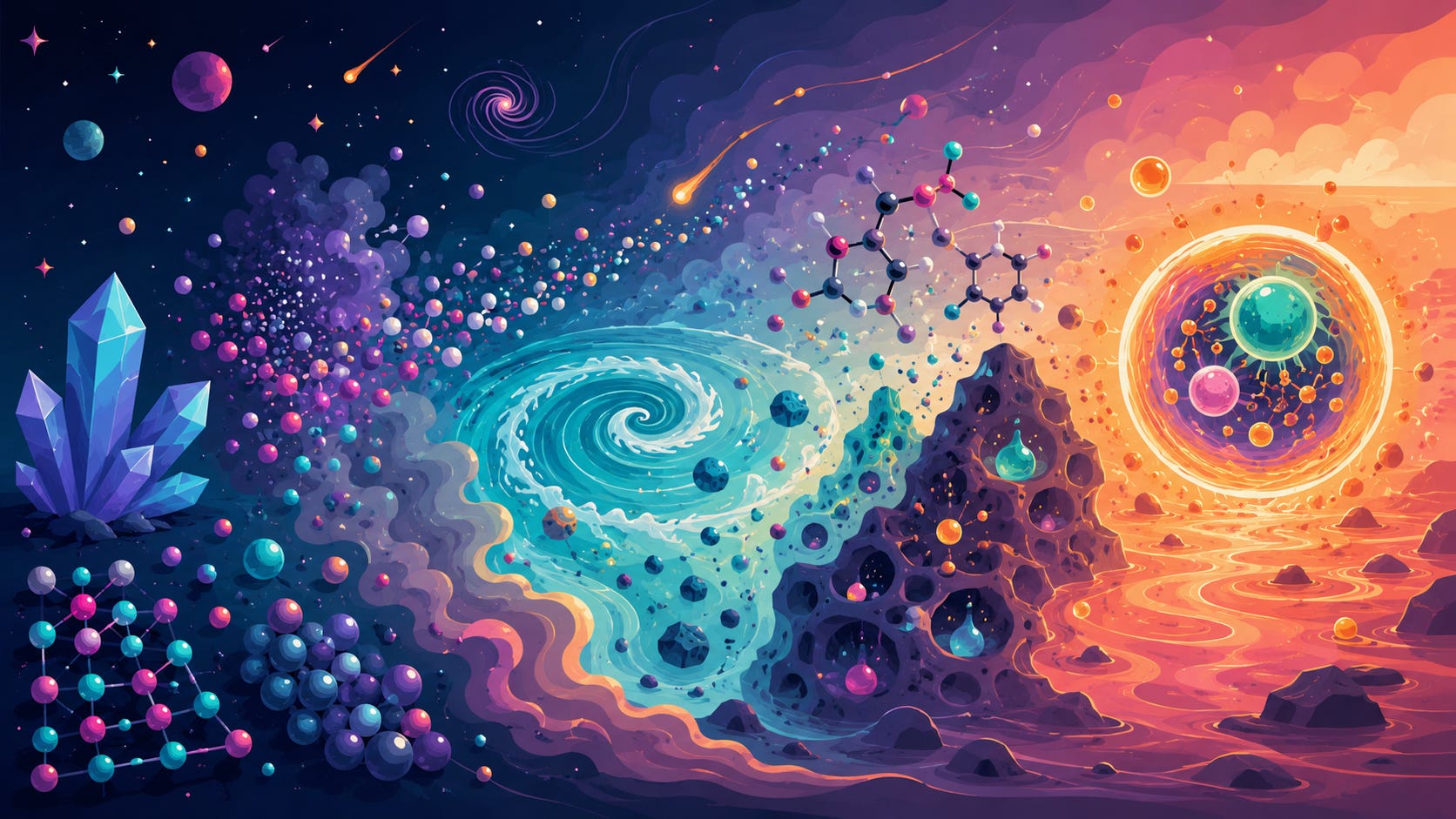
Consider a crystal. It is a conglomeration of atoms naturally arranged in a well-defined pattern. The pattern determines its form and rigidity, but a crystal is a static arrangement, it does not move, self-regulate, repair itself, adapt, or respond to the world except through ordinary physical interaction. The amount of information we need to communicate precisely what a crystal is can be simplified, because of these patterns.

Smoke, on the other hand, moves and changes its shape constantly. Smoke is also physical matter, made up of large numbers of particles that interact with each other, but here the particles are not arranged in well-defined patterns. They move around, collide, swirl, and spread. If we tried to describe all that microscopic activity in full detail, the description would be enormous. It would require that we track each individual particle and its interactions with surrounding particles. Smoke is hard to describe precisely, beyond some general statistical properties.

Considering these two simple examples, we can start to see why information matters when we talk about complexity.

But what kind of information is useful, and in what sense? A quick distinction may help. Data are recorded differences: positions, temperatures, symbols, measurements. Information is drawing inferences from data that reduces uncertainty in some context. Organized information is information embedded in relationships that produce stable effects. The last of these is the one that matters most here.

The crystal contains information in its structure, because the arrangement of its atoms reveals something fundamental about the rest of it. Describing the pattern compactifies the description. One no longer needs to describe exactly what each atom is doing, we describe the pattern without loss of information. Of course smoke contains information too, in a statistical sense. But that information is mostly not organized into stable patterns. It is hard to summarize because of its inherent messiness.

So complexity is not just about how much information is needed to describe something. There is something relevant about the nature of this information itself. What part of it is preserved, structured? Does local information carry over to other parts of the system in ways that are reproducible? Does it generate patterns that can persist, change in some predictable fashion, or be transmitted in some way or form? Or is the information indistinguishable from random noise?

Entropy measures the degree of disorder of a system. In information theory, it is more precise to think of it as a measure of uncertainty. Smoke for example, has high entropy because it is highly disorganized and we need excessive amounts of information to describe it precisely. It is not easily reducible. A random signal has high entropy because it is hard to predict. A regularly repeated signal has lower entropy because it is easier to predict. Noise can reveal broad statistical properties and temporary local patterns, but not patterns that persist, regulate, reproduce, or compound.

So the important question to ask is whether the information content is organized in some form. Does it carry patterns? Does the ordered structure regulate a process? Can it respond to changes without dissolving into noise? This is where complexity starts to become interesting, when it becomes organized and persistent.

Ok, but organized how?

A large pile of bricks and a house both have structure, but it is not organized in the same way. In the pile, the bricks are simply there, ordered or disordered. In the house, the position of each part relates to the function of the whole. Walls carry weight, doors allow passage without compromising the structure, windows let in light, and so on. The ordered complexity of the arrangement is necessary because each of the parts constrains and supports each other. All together, they serve some common function: to provide humans with a living space. This is artificial organization of course, but natural systems can also naturally develop ordered patterns that serve different functions.

A whirlpool, or a hurricane, also has some kind of organization that makes it more interesting than smoke. It can maintain an identifiable structure for some time. Energy flowing through its structure is one of the ways information propagates across the system. But these structures arise only under particular conditions. Remove those conditions, and the pattern quickly disappears.

So persistence of structures seems relevant when we are talking about ordered complexity, but persistence of ordered complexity alone is not a guarantee of compounding higher degrees of complexity. A rock can persist for a very long time, but its complex structure is not particularly exciting (unless you are a geologist, in which case, fair enough).

If we want to understand how organized complexity starts moving toward life, something more than persistence is required. A stable, reproducible pattern is needed, but additional activity is also necessary. Certain sufficiently complex patterns perform functions.

A flame maintains itself while fuel and oxygen are available. It replicates under the right conditions and converts energy. But it does not store information, does not alter its structure across generations, or build internal machinery to regulate itself. It operates in a limited fashion until the underlying conditions fail.

But there are also patterns that can preserve some part of their own organization across time. It happens all the time in chemical reactions across the universe, and one chemical element, Carbon, is exceptionally good at generating large complex structures by repeatedly bonding with itself.

Complex organized chemical structures gradually interacted in ways that produced more complex arrangements. They became larger organized structures with multiple components. Most of these arrangements formed, drifted, broke apart, or dissolved back into the chemical background, and nothing lasting came out of them. Remnants of such processes are in the dust and gas in the interstellar medium.

But there are places in the universe with abundant available energy and with very rich and diverse types of highly organized building blocks. And a tiny fraction of these building blocks randomly arranged themselves in patterns that began to chemically interact with their environment in more complex ways. Interactions between complex systems began to become complex themselves. Additional complexity compounds. Once a system has more parts interacting in more ways, it gains new degrees of freedom. More things can happen.

Chemistry determines what types of different complex molecules interact, and how, under local constraints. Some arrangements are more stable than others. Certain arrangements make other arrangements more likely. The degree of randomness is constrained because of energy conditions, molecular shapes, charges, relative concentrations, surface, temperature and pressure conditions, which all restrict what processes can take place. The possible combinations are vast, but not arbitrary.

If everything disperses immediately, the system has no local history. Useful products will drift away and reaction networks break apart. Locality means that the reactions take place in some kind of setting where their products remain near each other. This could take the form of a membrane, a droplet, a mineral pore, an ice pocket, or some other structure that preserves locality. The system needs enough separation from its surroundings for its internal state to matter. This sets up feedback loops inside that environment. Products accumulate, some reactions may become easier, structures can stabilize other structures, and some arrangements last longer, while others collapse.

Once variation exists, some versions persist better than others under those particular conditions. Certain patterns persist more efficiently and become more common. The loop now includes energy flow, locality, self-maintenance, information storage, imperfect copying and selection. The underlying system begins to participate in its own persistence.

The whole process acts as a filter. The pattern becomes part of a process that preserves and reproduces structure. Ordered complexity and information are no longer merely present in the arrangement. They begin to play a role inside the arrangement. This is the first major threshold.

Ordered complexity becomes the foundation of structures that persist, interact, regulate, and help generate more structure. The road toward highly complex systems, and perhaps toward very simple life, starts to barely become visible, though by no means inevitable. Under the right conditions, matter can organize itself into patterns that participate in their own continuation.

So the natural next question is this: at what point do some complex organized patterns become identifiable as life?


Further reading
If you want to dig deeper, here are some recommendations that explore these ideas: James Gleick’s Chaos for how simple rules can produce complex and unpredictable behaviour; Philip Ball’s Patterns in Nature for the way natural forms and structures arise without design; and Max Tegmark’s Our Mathematical Universe for thinking about reality as mathematical structure and pattern.

Related lighter and fun fiction
Olaf Stapledon’s Star Maker approaches cosmic order, life, mind, and civilization on the largest possible scale; Arthur C. Clarke’s 2001: A Space Odyssey explores intelligence, evolution, tools, and encounters with higher-order mystery; and Iain M. Banks’ Excession imagines advanced minds confronting something beyond their own frame of understanding.