
Thursday, 25 June 2009

Sunday, 21 June 2009
House of Flying daggers
House of flying daggers is admittedly on the same level as Crouching Tiger and Hero as far as the visuals are concerned - they are still stunning - and the acting & choreography of the fight scenes are superb. Where I found the film extremely lacking was the actual dialogue, which is the gist and soul of any movie, that even a clever twist of plot towards the end could not save.
Main themes are repeated and some things seem to be there just to have the character say something in their close up. But most ridiculous was the supposedly climactic fight scene in the end. The three main characters slash each other up over and over again losing tons of blood and piercing vital organs yet keep fighting with the same vigour and persistence, then they fall and you expect them to be dead but - lo! - they get up again and join the fray! Pierced liver, character down, two minutes later, hey,he's up again doing his thing. And then some. I couldn't help but laugh at the end. It brought to mind two scenes from Monty Python and the holy grail. That with the Black Knight: ............................. And the one with Launcelot and his horse that has just been pierced by an arrow: ............................. LAUNCELOT At last! A call! A cry of distress ... (he draws his sword, and turns to CONCORDE) Concorde! Brave, Concorde ... you shall not have died in vain! CONCORDE I'm not quite dead, sir ... LAUNCELOT (a little deflated) Oh, well ... er brave Concorde! You shall not have been fatally wounded in vain! CONCORDE I think I could pull through, sir... LAUNCELOT Good Concorde ... stay here and rest awhile. *He makes to leap off dramatically.* CONCORDE I think I'll be all right to come with you, sir. LAUNCELOT I will send help, brave friend, as soon as I have accomplished this most daring, desperate adventure in this genre. CONCORDE Really, I feel fine, sir... ...................................
I mean, come on!!
4/10
Main themes are repeated and some things seem to be there just to have the character say something in their close up. But most ridiculous was the supposedly climactic fight scene in the end. The three main characters slash each other up over and over again losing tons of blood and piercing vital organs yet keep fighting with the same vigour and persistence, then they fall and you expect them to be dead but - lo! - they get up again and join the fray! Pierced liver, character down, two minutes later, hey,he's up again doing his thing. And then some. I couldn't help but laugh at the end. It brought to mind two scenes from Monty Python and the holy grail. That with the Black Knight: ............................. And the one with Launcelot and his horse that has just been pierced by an arrow: ............................. LAUNCELOT At last! A call! A cry of distress ... (he draws his sword, and turns to CONCORDE) Concorde! Brave, Concorde ... you shall not have died in vain! CONCORDE I'm not quite dead, sir ... LAUNCELOT (a little deflated) Oh, well ... er brave Concorde! You shall not have been fatally wounded in vain! CONCORDE I think I could pull through, sir... LAUNCELOT Good Concorde ... stay here and rest awhile. *He makes to leap off dramatically.* CONCORDE I think I'll be all right to come with you, sir. LAUNCELOT I will send help, brave friend, as soon as I have accomplished this most daring, desperate adventure in this genre. CONCORDE Really, I feel fine, sir... ...................................
I mean, come on!!
4/10
Friday, 19 June 2009
Herschel’s daring test: a glimpse of things to come
19 June 2009
Herschel opened its 'eyes' on 14 June and the Photoconductor Array Camera and Spectrometer obtained images of M51, ‘the whirlpool galaxy’ for a first test observation. Scientists obtained images in three colours which clearly demonstrate the superiority of Herschel, the largest infrared space telescope ever flown.

This image shows the famous ‘whirlpool galaxy’, first observed by Charles Messier in 1773, who provided the designation Messier 51 (M51). This spiral galaxy lies relatively nearby, about 35 million light-years away, in the constellation Canes Venatici. M51 was the first galaxy discovered to harbour a spiral structure.
The image is a composite of three observations taken at 70, 100 and 160 microns, taken by Herschel’s Photoconductor Array Camera and Spectrometer (PACS) on 14 and 15 June, immediately after the satellite’s cryocover was opened on 14 June.
Herschel, launched only a month ago, is still being commissioned and the first images from its instruments were planned to arrive only in a few weeks. But engineers and scientists were challenged to try to plan and execute daring test observations as part of a ‘sneak preview’ immediately after the cryocover was opened. The objective was to produce a very early image that gives a glimpse of things to come.

To the left is the best image of M51, taken by NASA’s Spitzer Space Telescope, with the Multiband Imaging Photometer for Spitzer (MIPS), juxtaposed with the Herschel observation on 14 and 15 June at 160 microns. The obvious advantage of the larger size of the telescope is clearly reflected in the much higher resolution of the image: Herschel reveals structures that cannot be discerned in the Spitzer image.

Herschel’s glimpse of M51 at 70, 100, 160 microns.
These images clearly demonstrate that the shorter the wavelength, the sharper the image — this is a very important message about the quality of Herschel’s optics, since PACS observes at Herschel’s shortest wavelengths.
Produced from the very first test observation, these images lead scientists to conclude that the optical performance of Herschel and its large telescope is so far meeting their high expectations.
Within our Galaxy, the mission’s main science objectives are:
* To study Solar System objects such as asteroids, Kuiper belt objects, and comets.
Comets are the best-preserved fossils of the early Solar System, and hold clues to the raw ingredients that formed the planets, including Earth.
* To study the process of star and planet formation.
Herschel is unique in its coverage of a wide range of infrared wavelengths, with which it will look into star-forming regions in our Galaxy, to reveal different stages of early star formation and the youngest stars in our Galaxy for the first time. The telescope will also study circumstellar material around young stars, where astronomers believe that planets are being formed, and debris discs around more mature stars.
* To study the vast reservoirs of dust and gas in our Galaxy and in other nearby galaxies.
Herschel will study in detail the physics and kinematics at work in giant clouds of gas and dust that give rise to new stars and associated planetary bodies. Herschel is also well-suited to study astrochemistry providing fundamental new insight into the complex chemistry of these molecular clouds, the wombs of future stars.
Outside our Galaxy, the mission’s main science objectives are:
* To explore the influence the galactic environment has on interstellar medium physics and star formation. Most of what we have learned about the physics and chemistry of the interstellar medium, and of the processes there such as star formation, has been gained by studies in our own Galaxy. With Herschel, we can carry out similar studies in relatively nearby galaxies as well. For example, studies of nearby low- metallicity galaxies can open the door to the understanding of these processes in the early Universe.
* To chart the rate of star formation over cosmic time. We know that star and galaxy formation commenced relatively early after the Big Bang. We also know that when the Universe was about half its current age, star formation was much more intense than it is today. Herschel is ideal to study infrared-dominated galaxies at the peak of star formation.
* To resolve the infrared cosmic background and characterise the sources. About half the energy produced and emitted throughout cosmic history now appears as a diffuse infrared cosmic background. With its large telescope, Herschel will be able to resolve the far-infrared background and characterise its constituent sources to a degree never achieved before.
Herschel opened its 'eyes' on 14 June and the Photoconductor Array Camera and Spectrometer obtained images of M51, ‘the whirlpool galaxy’ for a first test observation. Scientists obtained images in three colours which clearly demonstrate the superiority of Herschel, the largest infrared space telescope ever flown.
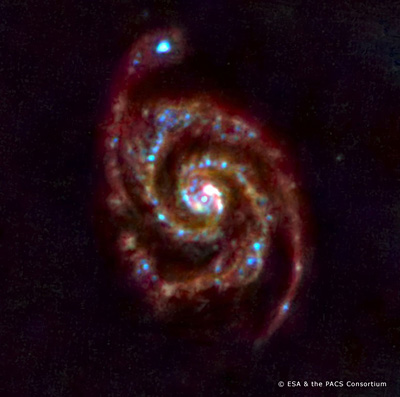
This image shows the famous ‘whirlpool galaxy’, first observed by Charles Messier in 1773, who provided the designation Messier 51 (M51). This spiral galaxy lies relatively nearby, about 35 million light-years away, in the constellation Canes Venatici. M51 was the first galaxy discovered to harbour a spiral structure.
The image is a composite of three observations taken at 70, 100 and 160 microns, taken by Herschel’s Photoconductor Array Camera and Spectrometer (PACS) on 14 and 15 June, immediately after the satellite’s cryocover was opened on 14 June.
Herschel, launched only a month ago, is still being commissioned and the first images from its instruments were planned to arrive only in a few weeks. But engineers and scientists were challenged to try to plan and execute daring test observations as part of a ‘sneak preview’ immediately after the cryocover was opened. The objective was to produce a very early image that gives a glimpse of things to come.

To the left is the best image of M51, taken by NASA’s Spitzer Space Telescope, with the Multiband Imaging Photometer for Spitzer (MIPS), juxtaposed with the Herschel observation on 14 and 15 June at 160 microns. The obvious advantage of the larger size of the telescope is clearly reflected in the much higher resolution of the image: Herschel reveals structures that cannot be discerned in the Spitzer image.
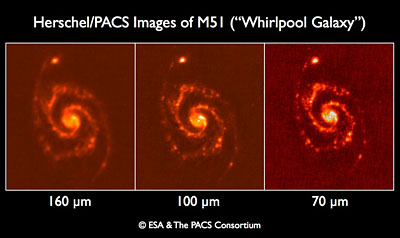
Herschel’s glimpse of M51 at 70, 100, 160 microns.
These images clearly demonstrate that the shorter the wavelength, the sharper the image — this is a very important message about the quality of Herschel’s optics, since PACS observes at Herschel’s shortest wavelengths.
Produced from the very first test observation, these images lead scientists to conclude that the optical performance of Herschel and its large telescope is so far meeting their high expectations.
Within our Galaxy, the mission’s main science objectives are:
* To study Solar System objects such as asteroids, Kuiper belt objects, and comets.
Comets are the best-preserved fossils of the early Solar System, and hold clues to the raw ingredients that formed the planets, including Earth.
* To study the process of star and planet formation.
Herschel is unique in its coverage of a wide range of infrared wavelengths, with which it will look into star-forming regions in our Galaxy, to reveal different stages of early star formation and the youngest stars in our Galaxy for the first time. The telescope will also study circumstellar material around young stars, where astronomers believe that planets are being formed, and debris discs around more mature stars.
* To study the vast reservoirs of dust and gas in our Galaxy and in other nearby galaxies.
Herschel will study in detail the physics and kinematics at work in giant clouds of gas and dust that give rise to new stars and associated planetary bodies. Herschel is also well-suited to study astrochemistry providing fundamental new insight into the complex chemistry of these molecular clouds, the wombs of future stars.
Outside our Galaxy, the mission’s main science objectives are:
* To explore the influence the galactic environment has on interstellar medium physics and star formation. Most of what we have learned about the physics and chemistry of the interstellar medium, and of the processes there such as star formation, has been gained by studies in our own Galaxy. With Herschel, we can carry out similar studies in relatively nearby galaxies as well. For example, studies of nearby low- metallicity galaxies can open the door to the understanding of these processes in the early Universe.
* To chart the rate of star formation over cosmic time. We know that star and galaxy formation commenced relatively early after the Big Bang. We also know that when the Universe was about half its current age, star formation was much more intense than it is today. Herschel is ideal to study infrared-dominated galaxies at the peak of star formation.
* To resolve the infrared cosmic background and characterise the sources. About half the energy produced and emitted throughout cosmic history now appears as a diffuse infrared cosmic background. With its large telescope, Herschel will be able to resolve the far-infrared background and characterise its constituent sources to a degree never achieved before.
Thursday, 18 June 2009
Porco Rosso
Take a bit of the essence of Casablanca, hints of the Marx Brothers, the dream travels of the Little Prince and a healthy dose of Japanese wackiness and you've got Porco Rosso. Known in Japan as Crimson Pig (紅の豚 Kurenai no Buta) this was the sixth anime film by Hayao Miyazaki, released in 1992, about an unusual Italian World War I pilot, now living as a freelance bounty hunter in the Adriatic.

Inspired by the writings of Exupéry and infused with Miyazaki's love of flying, it is the story of a "pig" that refuses to join the Italian fascist movement in the '30s. There's lots to enjoy in this film though a younger audience might miss the allegories.
Here's the trailer:
Sometimes when being human has lost it's meaning, it is better to be a pig...
8/10
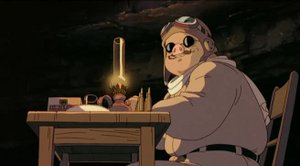
Inspired by the writings of Exupéry and infused with Miyazaki's love of flying, it is the story of a "pig" that refuses to join the Italian fascist movement in the '30s. There's lots to enjoy in this film though a younger audience might miss the allegories.
Here's the trailer:
Sometimes when being human has lost it's meaning, it is better to be a pig...
8/10
Subscribe to:
Posts (Atom)